
Pain Parity: Federal and State Action
The opioid crisis in the United States shows no signs of slowing, impacting communities and families across the country.
Between April 2024 and April 2025, over 48,000 Americans died from an opioid-related overdose,1 and 7.6 million Americans misused prescription opioids in 2024.2 Pain parity policies help ensure that patients can access FDA-approved, non-opioid treatment options without facing more restrictive coverage barriers than opioid medications.
At both the federal and state levels, lawmakers are advancing solutions to expand access to non-opioid pain management and reduce unnecessary opioid exposure.
Federal Landscape: The Alternatives to Preventing Addiction in the Nation (Alternatives to PAIN) Act
_________________________________________
The Alternatives to PAIN Act (H.R. 1227/S. 475), legislation recently reintroduced in the 119th Congress, can help prevent opioid addiction before it begins.
One underreported statistic has been the impact on our senior population: opioid-related overdose deaths have increased over 60% in the past decade among those ages 65 and older.3
In 2023 alone, 1.2 million seniors were diagnosed with an opioid use disorder, and more than 53,000 seniors experienced an opioid overdose.4
The Federal Landscape
The Alternatives to PAIN Act has bipartisan support to increase access for seniors to non-opioid pain management options in Medicare Part D.
The Alternatives to PAIN Act (H.R. 1227/S. 475) has been reintroduced in the 119th Congress by Senators Mark Kelly (D-AZ) and Thom Tillis (R-NC) and Representatives Mariannette Miller-Meeks (R-IA), Nanette Baragan (D-CA), Mike Kelly (R-PA), and Jimmy Panetta (D-CA). This bipartisan legislation will build on the success of past legislation, like the NOPAIN Act, by increasing access for seniors to non-opioid pain management options in Medicare Part D, which provides prescription drug coverage for nearly 52 million Americans.
The legislation would ensure that seniors have full access to non-opioid pain management options and allow patients and healthcare professionals to choose the treatment that is right for them. Under this bill, Americans on Medicare Part D and would never pay more for a non-opioid than they would for an opioid prescription.
FAQs: The Alternatives to PAIN Act
The Alternatives to PAIN Act is supported by over 120 organizations.
Voices is joined by 123 organizations in calling on Members of Congress to advance the Alternatives to PAIN Act. This widespread endorsement showcases the overwhelming support for this critical piece of legislation. With opioid overdose death rates continuing to climb, Congress must remain vigilant in fighting this crisis. Seniors deserve choices when managing their pain or recovering from surgery.
Read the Full Letter to Members of the 119th Congress HERE
Read our May Letter to Committee and Congressional Leadership HERE
Read our Letter to the Georgia Congressional Delegation HERE
Patients, especially America’s seniors, deserve access to safe, effective, FDA approved non-addictive forms of pain management options.
There is an immediate need for patients in the United States, especially our vulnerable senior population, to have unrestricted access to all forms of pain management, particularly those that do not include addictive opioids.
In April 2026, Voices was joined by 116 supporting organizations in sending a letter to the Centers for Medicare & Medicaid Services (CMS) encouraging the agency to use its existing authorities to ensure that Part D plans prioritize meaningful access to FDA-approved, evidence-based non-opioid medicines for acute pain.
Read the Full Letter HERE
By increasing access to non-opioids, the United States can drive down the rates of opioid misuse, stopping overdoses and ultimately deaths.
- In 2023, 1.2 million seniors were diagnosed with an opioid use disorder, and 53,165 seniors experienced an opioid overdose from prescription opioids, illicit opioids, or both.
- Despite a 40 percent nationwide decrease in opioid prescribing over the last decade, opioid prescribing in Medicare increased by 75 percent during that time.
- From 2022 to 2023, adults age 65 and older experienced the largest percentage increase in the rate of drug overdose deaths.
The NOPAIN Act, passed by Congress in 2022, gave American seniors much-needed access to non-opioid forms of pain management, but only in the outpatient surgical setting through a patient’s Medicare Part B benefit. The Alternatives to PAIN Act will build on that success in Medicare Part D to ensure America’s seniors can access novel forms of pain management.
Increased access to non-opioid pain management options could save billions in Medicare spending.
A new report conducted by the Moran Company, a Health Management Associates company, indicates that treatment of beneficiaries with opioid use disorder cost Medicare $33 billion in 2022.
This analysis highlights the significant economic burden associated with opioid use disorder in the Medicare program, shining a light on the importance of passing the Alternatives to PAIN Act to increase access to non-opioid pain management therapies under Medicare Part D and prevent opioid addiction before it begins.
Explore the One-Pager HERE
Read our Press Release HERE
Read the Full Report HERE
Poll: 86% of Seniors Say They Prefer Non-Opioid Treatments
An overwhelming majority of voters strongly support non-opioid pain management solutions and favor policies that increase access to these alternatives for seniors. Eight in ten voters believe patients should have equal access to both opioid and non-opioid treatments, and 86% of seniors said they would prefer non-opioid treatments when given the choice. This underscores the need to pass the Alternatives to PAIN Act to ensure all patients have access to safer pain management options.
Read our Press Release HERE
See the One-Pager HERE
Explore the Full Results HERE
Pain Parity Across the States
States across the country are pursuing a range of policies to expand access to non-opioid pain treatment. These include enacted parity laws, Medicaid parity policies, commercial insurance protections, and state studies examining access barriers. Together, these state efforts reflect growing momentum behind policies that ensure non-opioid treatments are accessible, affordable, and not disadvantaged relative to opioids.
A total of 26 states have laws or policies in place that prohibit preferencing opioid medications over non-opioid medications. Below is a map that outlines some of the approaches states have taken.
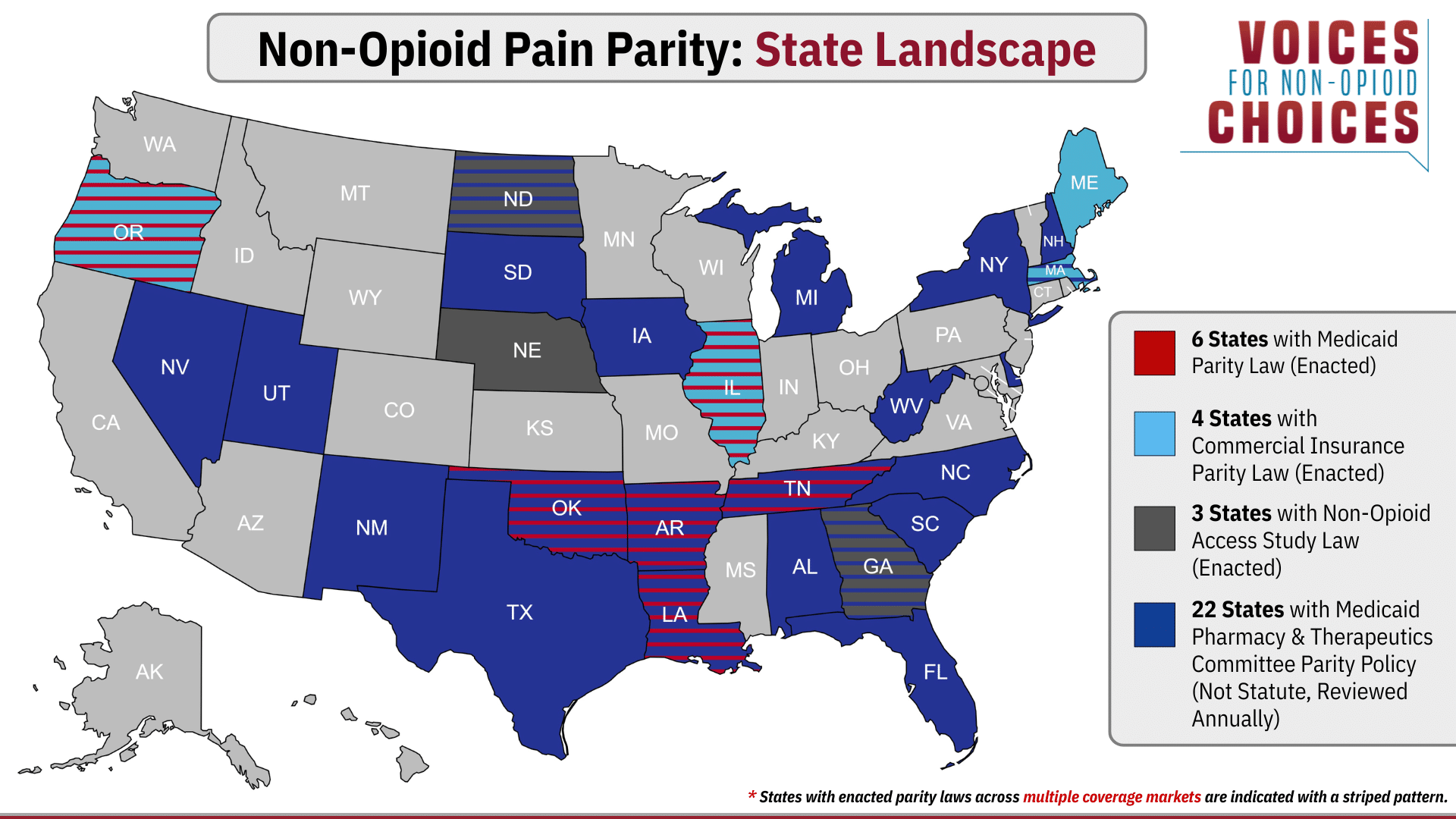
Find an interactive map to learn more about your state and related activity HERE
Alternatives to traditional opioids are vital to helping solve the opioid crisis.
Approximately 66 percent of drug overdose deaths were opioid-related from April 2024 – April 2025. Alternatives to traditional opioids offer patients an FDA-approved, safe, and effective option for the tens of millions of Americans who undergo an outpatient surgical procedure every year.
- Up to 90 percent of surgical patients receive an opioid prescription.
- Research shows that between 6 and 20 percent of these patients will develop become newly persistent opioid users.
These alternatives to opioids can help reduce opioid misuse, abuse, and addiction, saving both lives and strained fiscal resources of America’s health care systems.
- Recent research has found that replacing just 10 percent of new opioid prescriptions with non-opioid pain medications from 2025–2039 was estimated to prevent 323,000 opioid-used-disorder (OUD) cases, 11,000 overdose deaths, and save $88B.
- Increasing replacement to 25 percent could prevent 808,000 OUD cases, 27,000 overdose deaths, and save $221 billion from 2025–2039.
At the same time, innovation in non-opioid pain management is advancing.
In recent years, the FDA has approved new non-opioid therapies with novel mechanisms of action and there are dozens more in various stages of clinical development. These tools offer clinicians new ways to manage pain while avoiding the risks associated with opioids.
Learn more about the various non-opioid drugs in development HERE
Action to increase access to alternatives cannot wait.
Pain parity policies can help prevent unnecessary opioid exposure by ensuring patients have fair access to non-opioid treatment options. For more information, please contact info@nonopioidchoices.org